
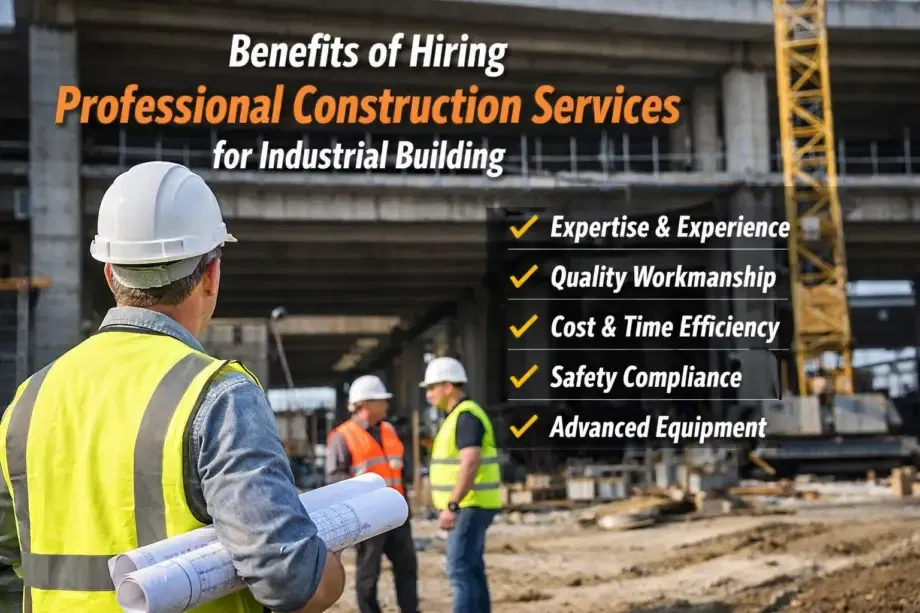

Most factory and warehouse projects in India don’t fail because of bad luck. They fail because the owner hired a general contractor who treats a 20,000 sq ft industrial shed the same way he’d treat a farmhouse in Noida. The foundation specs are wrong, the drainage plan doesn’t account for monsoon runoff, and the flooring cracks under machinery weight within eighteen months. By then, the contractor has moved on to his next project, and your calls go unanswered.
Professional construction services exist specifically to prevent this.
Why Industrial Building Construction Needs Real Expertise
Industrial building construction deals with forces that residential and even most commercial projects never face. We’re talking about crane loads of 30 tonnes or more pressing down on specific column points, chemical spillage eating through standard concrete, exhaust fumes that corrode cheap steel within a few years, and vibration from running equipment that slowly loosens every bolt in the structure if the foundation wasn’t designed to absorb it.
A contractor who built a great bungalow last year won’t know how to handle any of this. Professional firms, on the other hand, employ structural engineers who’ve spent years calculating these loads and specifying the right materials for each situation. They also work with pre-engineered building (PEB) systems that shave 30-40% off your construction timeline compared to conventional methods, which gets your production line running months sooner.
What the Best Construction Companies in India Do Differently
The best construction companies in India won’t touch a site until the homework is done. Soil testing, wind load analysis, water table assessment, and environmental clearances. Some of these take weeks, and that’s fine because skipping them creates problems that take months to fix later.
Consider what happens when a contractor pours a foundation without checking for expansive clay soil. The ground swells during the monsoon, shrinks in summer, and your foundation cracks. Machinery mounts shift by a few millimeters, which is enough to throw precision equipment out of calibration. The repair bill usually runs higher than the soil test would have cost.
Professional firms also run their sites differently. Material procurement is tracked digitally, trades are scheduled so plumbers aren’t waiting around for electricians to finish, and you get photo-documented weekly reports instead of verbal reassurances over the phone.
Safety and Compliance in the Building Construction Industry
A single failed safety inspection or missing environmental clearance can shut your project down for weeks. It happens more often than people realize, especially on industrial sites where BIS codes, municipal building regulations, and pollution control norms all apply simultaneously.
The building construction industry in India has strict rules around structural load limits, fire safety, seismic resistance, and worker protection. Professional contractors maintain current licenses and train their crews specifically for industrial site hazards because the penalties for non-compliance aren’t just fines. They’re project shutdowns.
On the structural side, this means columns and beams designed with proper safety factors, steel sourced from mills with test certificates (not the cheapest stock from a local trader), and IS code compliance specific to your region’s seismic zone. These aren’t details you want someone figuring out on the fly.
The Real Money Story
The cheapest quote almost always ends up being the most expensive project. Low-bidding contractors survive on change orders. They leave items out of the initial scope on purpose, then charge premium rates to add them back once work has started and you’re locked in.
A professional firm works differently. You get a detailed bill of quantities before any construction begins, with every line item priced and specified. When changes happen (and they do on every project), there’s a formal process with your sign-off required. Established firms also buy materials in bulk across multiple projects, so their steel and cement costs tend to run 10-15% below market retail.
How to Pick the Right Industrial Building Construction Company
Skip the brochures. Ask to see completed factories, warehouses, and processing plants. Call those clients and ask two questions: did the project finish on time, and would you hire them again?
An industrial building construction company that’s serious about its work will have structural engineers on payroll, not freelancers brought in per project. They’ll share documentation without hesitation, and they’ll offer post-construction services like foundation settlement monitoring and waterproofing warranties if a firm gets uncomfortable when you ask for references, that tells you everything.
FAQs
What does this type of construction involve?
It covers designing and building structures meant for manufacturing, warehousing, processing, and logistics. These buildings face heavy equipment loads, chemical exposure, heat, and constant vibration, so they need specialized engineering that goes well beyond standard construction.
How to find reliable construction companies for a project?
Look at their completed industrial work, not just residential or commercial jobs. Call past clients directly. Verify BIS compliance and check whether they have structural engineers on staff or outsource the technical work.
What’s a realistic timeline for an industrial building project?
A straightforward warehouse can be done in 4-6 months. Larger manufacturing facilities with complex MEP systems and specialized flooring usually take 12-18 months from design to handover.
Why not just hire a local contractor?
Local contractors build well within their expertise, but industrial projects require load calculations, compliance knowledge, and project management systems that most small firms simply don’t have. The lower quote looks attractive until rework and delays eat through whatever you saved.
Why Clients Trust Thikedaar?
Thikedaar is among India’s first construction companies to run a fully digital service portal. That means you can plan your project, pick designs, approve materials, and track construction progress from your phone or laptop without visiting a single office.
But the technology is just the front end. Behind it, our team handles residential, commercial, and industrial projects end to end. Planning, architectural design, engineering, construction, interiors, renovations, and ongoing maintenance all sit under one company. For an industrial project, that means your factory design, structural engineering, MEP work, and finishing are all coordinated internally rather than split across five different vendors who don’t talk to each other.
We operate from offices in Gurugram, Patna, and Ranchi, and we take on projects across India. Our approach is simple: you share your requirements and budget, and we build a plan around both.
Call us for a free construction estimate. You can also visit thikedaar.com to explore our services and get started online.
Check out our detailed guide on: Turnkey Contractors