
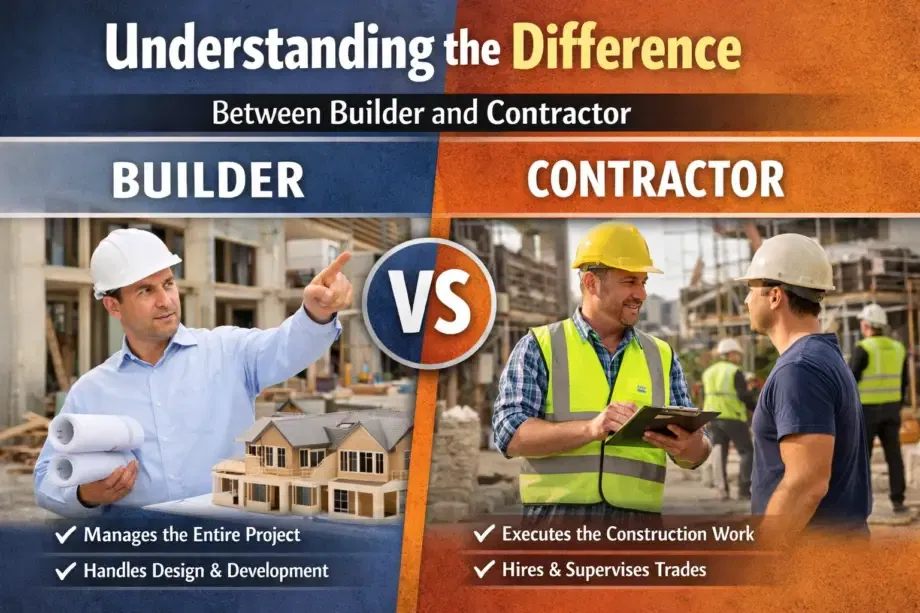

Once you secure a plot of land, the immediate next step involves hiring the teams who will actually pour the concrete and lay the bricks. Every day, conversations treat the terms ‘builder’ and ‘contractor’ as if they mean the exact same thing, but this fundamental misunderstanding usually results in terrible vendor contracts. Construction halts halfway through a build simply because no one knows who is legally responsible for a delayed steel shipment. You must define these distinct roles clearly before handing over your first cheque.
The Core Scope and Responsibilities
The main difference between a builder and a contractor is in project ownership, management duties, and how risks are shared. A builder oversees the entire construction process from start to finish, including handing over the finished project to the client. They collaborate directly with landowners to coordinate the schedule, budget, and municipal permits. Their focus is completely holistic. They ensure the architectural design aligns with local building codes. If the local municipality halts work due to a zoning issue, the builder handles the legal friction.
Contractors focus purely on execution. They are hired to perform specific, rigidly defined tasks on the site. A builder will typically hire multiple contractors for a single project. One specialized team handles the deep foundation work, another executes the internal electrical layout, and another installs the high-pressure plumbing network.
Defining the Building Contractor
A building contractor manages the physical labor, heavy machinery, and daily material procurement for their designated segment of the project. They look at the technical structural drawings and turn them into physical reality. They handle the daily workforce on the ground. If a cement delivery is delayed or a critical worker does not show up for a shift, it is the contractor’s immediate problem to solve. They operate strictly within the bounds of their specific contract and do not manage the broader architectural timeline.
Key Operational Realities on Site
To see how these roles function practically, observe a typical day on an active site:
- Handling Design Alterations: If you choose to move a load-bearing wall by two feet during the project, the builder reevaluates the structural load and obtains revised blueprints. The contractor simply halts their physical labor until the new drawings are handed to them.
- Material Procurement Strategy: Builders often negotiate bulk material rates directly from manufacturers to secure the project’s financial baseline. Contractors generally purchase smaller batches on shorter notice because their cash flow depends heavily on weekly progress payouts.
- Site Safety and Liability: The overarching safety perimeter, site fencing, and primary insurance are established by the builder. The contractor is only responsible for ensuring their specific crew wears hard hats and uses safety harnesses while on scaffolding.
Adding the Real Estate Developer
Adding a real estate developer to the mix changes the project structure entirely. The difference between builder, developer, and contractor centers heavily on financial risk and land ownership. A developer purchases raw land. They obtain the necessary commercial or residential zoning approvals, secure the massive project financing from banks, and handle the sales or leasing of the finished property. The developer takes on the primary financial risk of the entire venture.
Once the funding is secure and permits are in place, the developer hires a builder to execute the overall construction framework. The builder then hires specialized contractors to do the manual labor. In some residential subdivision projects, a single corporate entity acts as both the developer and the builder. The contractor always remains the entity executing the physical labor under a defined operational agreement.
Why Specialized Execution Limits Large Projects?
If you own a large commercial plot and want a multi-story structure, hiring a building contractor alone usually results in severe administrative bottlenecks. You need a central authority to coordinate the various specialized teams, manage city inspections at different stages of concrete curing, and ensure the structural integrity holds together across different phases of work. A contractor will only manage their specific vertical and ignore the rest of the site.
Adapting to Industry Demands
Industry fragmentation causes severe delays and massive budget overruns. Clients waste hours managing multiple points of contact across different trades. The best construction companies in india recognize this workflow inefficiency. To solve it, top firms offer comprehensive end-to-end services. They act as the primary builder and employ an extensive network of verified, in-house contractors. This consolidated model eliminates the usual blame game when a site delay occurs. Accountability rests with one central management team.
Choosing the Right Setup for Your Site
If you possess deep technical knowledge of civil engineering and have the time to be on-site daily, you might act as your own builder and hire contractors directly. Most property owners lack this niche expertise. They require a professional entity to shoulder the administrative burden and guarantee the structural outcome.
Owners who attempt to self-manage fragmented teams quickly encounter harsh site realities:
- Resolving bitter disputes between the electrical and plumbing crews when their layout conduits clash inside a narrow concrete shaft.
- Scrambling to source replacement floor tiles when the primary supplier unexpectedly delays a crucial shipment by three weeks.
- Dealing with local municipal inspectors who arrive unannounced, demanding immediate proof of structural compliance during an active concrete pour.
Managing a site consumes hours you simply do not have. You end up wasting Saturday mornings arguing with steel vendors or trying to figure out if the concrete mix is right. It quickly becomes a highly stressful second job. Thikedaar absorbs that friction because we operate as the central builder. We enforce the blueprints, manage the specialized contractors on the ground, and shoulder the overarching legal liability. You bypass the daily site chaos.
FAQ
What is the primary difference between builder and contractor regarding liability?
If a concrete slab fails, the contractor who poured it is liable. If the city halts construction over zoning, the builder faces legal consequences.
How does the difference between builder developer and contractor affect homebuyers?
You only deal with the developer. If possession gets delayed, the developer might blame the builder, who blames a contractor. That is not your problem. The developer holds the ultimate delivery obligation.
Why prioritize the best construction companies in india over unorganized crews?
Unorganized crews disappear after the final payment. If a concealed pipe bursts years later, they won’t return. Established firms operate on strict contracts and issue formal structural warranties.
Who handles labor payments?
You pay the builder based on milestones. The builder manages daily contractor payouts. You bypass all wage disputes entirely.
Check out our detailed guide on: Best Construction Companies in India